
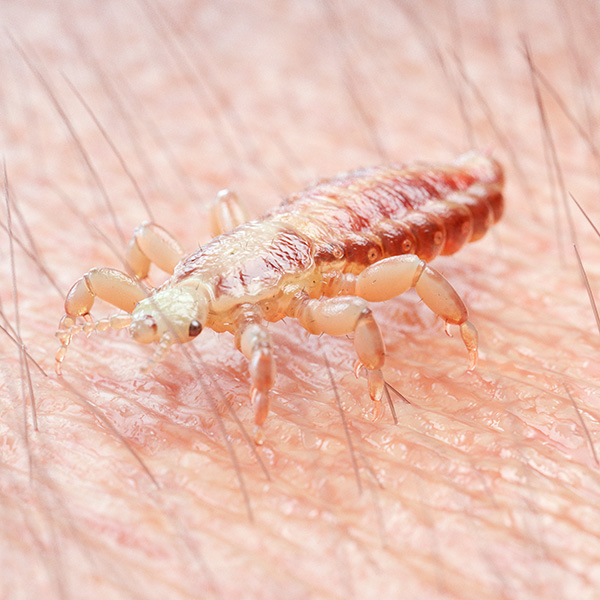
Head louse, Human louse
Pediculus humanus capitis
- Insect with chitinous carapace
- Flying, stinging, bloodsucking
- Parasite
- Annoying pest
- Hygiene and health pest


Head lice are significant parasites and disease vectors for humans. They preferentially infest children and young people in schools. People infested with head lice transmit them to their fellow human beings through physical contact.
Ttransmission of diseases
- Studies have shown that head lice can transmit Rickettsia platensis (causes typhoid fever) and Bartonella (causes 5-day fever). These dangerous bacteria are very rare in Europe, but very common in some developing countries. When sucking blood, the bacteria enter the human blood via the saliva of the head lice.
- Pus pathogens can be transmitted passively from the infected area of the scalp through the legs and body of the lice to other areas.
- The skin’s immune system recognises the components of the lice’s saliva as foreign bodies and reacts to them with a delayed immune response. This manifests itself in a small swelling (papules) of a few millimetres to one centimetre on the scalp. This swelling is very itchy. The unpleasant itching can lead to scratching. If the inflamed area is scratched heavily, the scalp is destroyed (the epidermis falls off). Long-term skin lesions can cause ulcers. Exfoliation and ulcers are entry points for purulent pathogens (streptococci, staphylococci). If the bacterial infection of the scalp persists and is not treated, the regional lymph nodes swell.
- In the case of an initial infestation, symptoms only appear after 3-5 weeks, so that parasitic infectious diseases are usually only detected at this time. This means that the affected person has been infected for several weeks and may have infected others. If the scalp is infested again after a healed pediculosis captis, symptoms already appear after 48 hours.
In which area does the pest occur?
The area of application decides which products are recommended to control this pest.